Trinity in Man and God
God is the supreme source of all beings in whom the three (Thinker, thought, object of-thought) are one. Matter, Form and Will are one in God, though in man they appear separately. It is questionable whether the three in man are not one. The soul of man is a continuum of sentient power, able to will any number of courses simultaneously. Each willed course formulates a definite amount of energy in a definite way. Thus in each willed course the Will, the willing process, and the object willed, are one. In man there are usually many purposes willed at once, each being a trinity of will, form and process.
Because the multiplicity of purposes in man may contradict each other it often appears that man's will, idea and action are not coincident. But this lack of coincidence is not in each willed object process, but in the contradictory nature of many such, incompatible in their nature. Thus arises in man the apparent separation of will, idea and action. But if man concentrates all his power and focusses it in one only direction, then his will, idea and action, having nothing other in him to contradict him, must by their consistency be one.
It follows that, as in God Will, Idea and Action are one, God must be willing, thinking and doing only one thing. He must have only one purpose, for only in one purpose may unity be attained. What, then, is God's one purpose?
It is said that God is Love. In what way may we define Love so that it will fulfil the required condition of a unific purpose? Simply we may define Love as the will to work for the optimal development of the potentialities of being. God wills all ways and everywhere the development of the optimal potentiality of being.
Because optimal development of being-potentialities implies the development of optimal relations between beings (for a being cannot show all its potentialities in isolation, part of such potentialities being by their nature relational ones) therefore in willing optimal development of being potentialities, God is willing the relations between beings needed for such development. The meaning of a cogwheel is fully seen only when it is meshed with another. Likewise the meaning of any characterised being is fully seen only when brought into relation with one or more other beings.
By willing the optimal development of all beings and all that is implied in this, God maintains the unity of His Will, Idea and Action. By willing the same, man also may maintain such unity.
To will as God wills, to think as He thinks, to act as He acts is simply to work for, think of and will, the optimal development of the potentialities of being, that is, to love.
In practice a man is to see that whatever any being is willing, thinking or doing is so because that being so wills, thinks, or does, according to its own inner processes and its relations with other beings.
As each being is a creature of God, brought into being by God, each being must have functioning within itself the purpose of God, that is, the love of God, the will, idea and action of God, urging it to develop its potentialities to their optimum. As this is so, how is it that not all beings appear to be moving towards their optimal development? How is it that some human beings exhibit actions which may only be interpreted as a will to negate their own potentialities, even to destroy their own being?
There is in this world not only the will to love and live; there is also a will to hate and kill; not only to hate and kill others, but also to hate and kill, sometimes, oneself. How does such a will appear in a creature whose essential source is a God of Love?
To answer this question we will use the story told in the Bible in the book of Genesis about Adam and Eve, and how they came to be expelled from the Garden of Eden.
Adam has been commanded by God, the same God who is the God of Love, not to eat of the fruit of the tree of knowledge of good and evil. God has told Adam, "If you eat of this fruit you shall die."
In the Garden is a serpent, and this serpent goes to Eve and tells her that she may eat the fruit and not die.
Eve is thus presented with a problem. God has said the fruit will bring death. The serpent has said it will not bring death.
Now, whenever two beings make statements which contradict each other, either the words used or the things signified by the words have not the same significance for the two beings.
For God, "to die" means to be divided from God, that is, Good and Love.
For the serpent, "to die" means to lose one's life, which is not possible in principle, for life is eternal. The serpent, sloughing its skin, symbolises the eternal life ever encasing itself in a body and then renewing its case, itself remaining what it eternally is - life itself.
When God said to Adam "You shall die" He meant "You will be divided if you choose to separate good and evil as if they were two substances; you will lose your unity of will and dissipate your energies and so become inefficient and suffer the consequences of your inefficiency."
When the serpent said to Eve "You shall not die; the fruit is good to look at, pleasant to taste, and confers knowledge like God has," he meant "Your life principle is eternal and therefore in itself immortal, and if you remember this you can go out to enjoy the world, taking from it what is pleasant and avoiding what is unpleasant."
Eve is presented with two statements about knowledge and death, one from within, the other from without, from the serpent. She is thus presented with an occasion of choice, by the free exercise of which she may realise the nature of her own being and of the universe.
Eve, of course, had not yet experienced the meaning of "death", either in God's sense of the word, or in the sense used by the serpent. She was, therefore, not yet equipped to make an intelligent choice. Intelligence is that which sees the way to realisation of a purpose. Eve did not have any purpose in eating the fruit until the serpent suggested to her that it would be pleasant to eat, etc. Then she accepted this suggestion without first seeing clearly the results of her action, nor with a full knowledge of its implications. Therefore we cannot say that she acted intelligently. We may act intelligently only where we are able to define a purpose and the means to its realisation. We cannot say that Eve did either with any large degree of efficiency.
God had spoken to Adam from within. The serpent spoke to Eve from without. Eve, having accepted the serpent's suggestion, then gave some of the fruit to Adam. Adam was thus placed in the position of choice. God's voice spoke to him from within, now in his memory. The serpent's voice, through Eve, spoke to him from without. Adam could have listened within to God's voice. Instead he acted upon Eve's serpent-insinuated voice. He acted no more intelligently than Eve. Both were cast out of the Garden and condemned to hard labour and death (in God's sense of the word). The serpent's vision of death they did not experience, but outside the Garden the pursuit of pleasure in the light of the knowledge of good and evil proved less profitable than they had anticipated.
When the serpent spoke to Eve, she received a stimulus from outside herself. Acting upon the serpent's suggestion exposed her and her spouse to further external stimuli. It is the accumulation of unhappy and painful experiences and the thwarting of the will to pleasure, that gradually builds up in man the negative states of hate and the will to kill and be killed. Here is the source of all anti-life impulses.
When the recorded experiences of frustrating situations, and unpleasant sensations, and painful wounds, psychical and physical, have accumulated in the organism sufficiently to outweigh the records of the situation of fulfilment and the moments of pleasure and happiness, then the will to live tends to lose its force. It is almost, but not quite, a quantitively determined situation. The being in whom the negative records of experience outweigh the positive records is highly likely to act negatively. If it were not for the fact of God's will to develop man's potentialities of being, there would be a high probability that he would give up his struggle against the anti-life experiences.
But God is a free, intelligent power acting for the ultimate fulfillment of His purpose. God is that supreme infinite sentient power in whom we live, move and have our being. Because we live in Him we are not cut off from Him. Our being is the manifestation of His power. His sentience and power are at the centre of our being, welling up and illuminating and energising us. Only our outward-turned serpent-directed will blinds us to this fact. We have but to turn our attention away from the periphery of our being, and turn it inward to the ever-uprising intelligent power springing from within our centre, and we shall re-enter into the Garden we once left.
Yet there is a "fiery sword" guarding the entrance to the Garden to stop us returning into the Garden before we have thoroughly learned the lesson of Adam's and Eve's error.
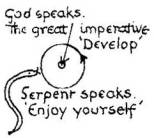
Adam and Eve erred in subordinating themselves to a stimulus coming from beyond the periphery of their being. They turned away from the voice of God and His love and the great imperative within, "Develop thyself", and enslaved themselves to the external serpentine suggestion "Enjoy thyself". They did not see the consequences of their choice until their choice had become operative in the physical world, although it was not absolutely beyond their power to have resisted the external stimulus.
We may find, if we wish, an excuse for their error. God gave them about this fruit one only command: "Do not eat it". The serpent, however, gave several suggestions. "It is good to eat, pleasant to look upon and confers divine knowledge". In terms of energy-input it would appear that the serpent was rather tipping the scales in the direction of eating. And God, who, of course, in His omniscience knew this, did not, apparently, throw into the scales anything extra on His side to balance it up. We shall show that God's omniscience contained elements of which Adam's ignorance was void.
What would have happened if Eve had not responded to the serpent's hissed suggestion, had not persuaded poor Adam to participate in her sin?
The Garden of Eden was a very pleasant place, sheltered by a wall from the threatening violence of nature beyond. In it Adam and Eve might have fulfilled God's will for them, might have spent eternity there, tending the beautiful flowers and eating the pleasant fruits and herbs of the Garden. Their lives would have been pleasant and productive only of good. Joy would have been theirs forever.
But in such a state of happiness, would they have developed their potentialities to the full? Would they have grown in understanding of all the possibilities of being? No. Of the possibilities of happiness they would have known all. But of the possibilities of unhappiness they would have learned nothing.
Has unhappiness something worthwhile to teach us? It has. It may teach us the full meaning of God by showing us what God is not. It may teach us what God has accomplished for us in swallowing up in His own Goodness the Evil which would otherwise manifest to us. He swallows it as a white cell in our bloodstream swallows up bacteria and other things inimical to our life.
When we have understood fully the message unhappiness has for us, then, and only then, shall we be allowed to pass the flaming sword and reenter the Garden of supreme joy.
Unhappiness, misery, pain, suffering. These have something to say to us. They have something to tell us about what God has done for us in swallowing them up. God has solved the problem of Good and Evil. He offered Adam the fruits of His solution.
He offered Adam the fruits of the whole Garden, in which grew also the Tree of Life. He told Adam only one thing not to do, not to eat of the fruit of the Tree of the Knowledge of Good and Evil. God in His omniscience knew this Tree's fruits and what it spelt to those who eat it - Death. He knew this both in principle, from the inherent Logos of His own Being, and in act, from His own actualisation of the creative process of the world.
God, in His omniscience and creative actualisations, experienced the separation of Good and Evil. He knew what it was like to experience these two in separation from each other. He knew they were better with the Evil swallowed up in the Good, and with the Evil swallowed up in the Good He made the world and all things in it, and "saw that it was good".
Food without salt is not so palatable as with it. But if the Food is placed on one plate, and the Salt on another, and we are required to eat them one at a time, our enjoyment will be less than if we are allowed to eat them together. So it is with Good and Evil.